
Are basic resume mistakes losing you the interview opportunities you deserve?
You’re applying for jobs in Japan but not getting interviews. There can be multiple reasons for this, and one of them is the quality of your resume.
In this article, I want to address 7 resume mistakes that could be holding you back. We’ll step through each with examples and look at the fixes so that you can improve your resume and get more interviews.
Most of the lessons here apply to tech professionals anywhere, but several are specific to Japan.
Note: I’ll use examples from a software engineer’s resume in this post, but the advice is applicable across tech roles.
Good resume, bad resume
To understand a bad resume, let’s consider a good resume.
To me, a good resume is a clear and concise summary of your professional experience, skills, accomplishments and motivations (with relevant extras thrown in like your education, certification, working visa status, location, etc., when appropriate), used to showcase your suitability for a particular job and get you an interview.
A bad resume is simply… the opposite. Unclear, not concise, not showing your experience, skills & accomplishments, and not showcasing your relevance and suitability for the role you’re applying to.
With this in mind, let’s review 7 of the most common mistakes I see on resumes every day and what you can do to fix them.
1. The “I Don’t Know What You Do” Summary
Here is the Summary from the start of someone’s resume:
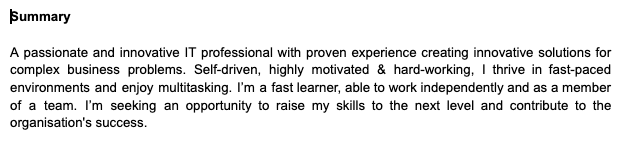
Question – Do you have any idea what this person does?
“Something-something IT something-something?”, I hear you say.
Yes indeed. I have no idea either. Yet I read many summaries like this every day.
I think you need a great Summary at the start of your resume. This is prime resume real estate. You have a chance to grab the reader’s attention, to show them that you are the person they are looking for and that they should read on.
So, what should you write? I recommend starting with a simple 3-5 sentence overview of what you have done and can do, written in plain language. No generic blah blah or buzzwords. No need to sound like you’ve swallowed a corporate jargon dictionary. Just tell me like I’m an idiot (you’re probably right!)
Then, customise it based on the key points from the job description of the role you’re applying for. (Yes, many job descriptions are rubbish, but hopefully, you can find the key points of the role and align yourself with them)
Example: you’re reading a job description that’s looking for a fullstack JavaScript developer with some experience in microservices, cloud deployment, etc. The company runs a successful eCommerce website with millions of customers. It’s a large, well-established company with an IT group building systems in-house (this kind of info you can find in the job description or online if you look around). This sounds like you and you’re excited to apply.
How about the following?
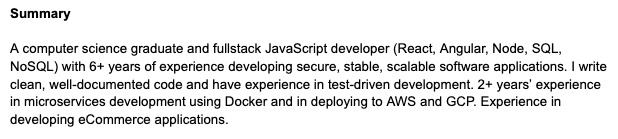
It’s brief and specific, written clearly and simply, highlighting how your skills and experience fit the role and inviting the reader to continue reading. You get the idea.
If you don’t have all the exact skills they’re looking for, show similar ones. If you don’t have any of the skills, you’re probably better off saving your time and applying for something else.
Depending on your skills and role, you might want to add some bullet points under this text with specific skills you’d like to highlight (like leadership experience, people management, etc.). Go ahead, just keep things simple and concise.
There’s no need to write that you are a hard worker or a fast learner or other generic attributes like these. It’s fluff and it does nothing to show who you are and what you can do.
2. The 30 Bullet Point Summary or The Full Page Summary
Keeping on page 1 of most resumes, what’s worse than the “I Don’t Know What You Do” Summary? The “30 Bullet Point Summary” (sometimes seen in the wild as the “Full Page Summary”)
As you might guess from the name, this is a summary filled with bullet point upon bullet point of everything the writer has ever done in their career. (Often, it’s a cut & paste of points made further down the resume in the Work Experience section)
Take a look at this:

Noooooooo!
It’s not that there isn’t useful information in here – there definitely is. But the information here is not concise (too many “Experience in” type of bullets, many of the technical skills can be grouped together for easier understanding), it’s not clear or well organised (there are technical and non-technical points mixed together, skills information is duplicated), and so on. It’s just not an easy read and this means you’re not effectively communicating what you want to say.
Sometimes I see this amount of data without the bullet points, just written in prose paragraphs, and that’s even harder to read and understand.
The place to highlight this level of detail is in your Work Experience section, where actual context can be seen – Where did you do this? When did you do this? How long did you do it for? What were the results & achievements? I’ve seen summaries with 30+ very detailed bullet points that fill pages one and two of the resume. Now your current job is on page three (not good).
Write something clear, concise, and organised, as per point 1 above. Your Summary should never be the longest section of your resume.
3. The Technical Skills Dump
Moving on to the Technical Skills section of the resume (and if your job relies on technical skills, make sure you have one of these), feast your eyes on this beauty:

This isn’t easy to read. It’s disorganised and hard to get an overview of.
Fix this with two steps:
- Delete anything that’s out of date or that you don’t want to be asked questions about in an interview. There’s no need to show every little thing you’ve ever used, especially if you’re very experienced.
- Put some structure on it. The format of the structure is up to you, but something like the following:

And so on. Obviously, tailor the headings to your particular set of skills and experience – it will look very different if you’re a desktop engineer, a UI/UX designer, or a CTO.
4. No Tech Stack in your Jobs
I’ve read your Summary and you sound interesting. I’ve reviewed your Technical Skills and I see the technologies I’m looking for. Now, I’m reading about your work experience and want to see how and where you’ve used those skills. But instead, I see something like this:

and so on for the rest of your work experience. You say you’re experienced with JavaScript, but I don’t see JavaScript anywhere in your professional experience. Stating you have skills is not enough to get an interview, especially for highly competitive jobs. You need to show how you’ve used your skills.
But all is not lost, you can fix this easily enough.
If you were generally using the same tech stack during your whole time in a role, simply add a final bullet point or line stating the stack, such as:

If, instead, you worked on a variety of technologies on different projects, you can note them in the individual bullet points of each project, like so:

5. The Long, Unnecessary Project Description
Here’s another paper saver. If you write very long descriptions of projects you’ve worked on, you can probably delete much of this and have a much shorter resume as a result. Having a very long resume isn’t generally necessary for the English-speaking tech market in Japan, and in fact, it can turn some companies off (for example, if they think your communication style is long-winded because your resume is 12 pages).
Take this example:

You don’t need to go into all that detail about system functionality. It’s not relevant to someone outside that organisation (or a very similar one) and it’s not adding any useful information about you. It’s also a project from 16 years ago, so it’s unlikely to be very relevant to the role you’re applying for now.
Cut it down to something like this:

This is now 6 lines, instead of 24 lines, a 75% reduction – this is one way to significantly reduce the length of your resume. Note also that I’m not using tables in the new version, just setting tabs/using bold, but it’s still perfectly readable. (Tables don’t import well into recruitment databases so I avoid them)
If the reviewer wants to drill down into the details (for example, to understand your knowledge of a particular business domain or process) they can ask you during an interview. Of course, feel free to write more about projects that are relevant to the job you’re applying for and for more recent experience if that helps sell your skills.
My final two points are Japan-specific.
6. You're in Japan but your resume doesn't clearly show it
Although many companies here are open to hiring from overseas, most prioritise local applicants, especially applicants who already have permission to work in Japan, a track record of employment here, and so on.
If you’re local, but this isn’t clear on your resume, it can cost you an interview request. It may sound obvious, but I see resumes from Japan residents who can easily be mistaken for an overseas applicant.
If you’re in Japan, make sure you:
- Clearly state your location at the top of your resume with your personal details. No need for a full address, just “Tokyo”, “Osaka”, etc., is fine.
- If you have permission to work in Japan, state this at the top of your resume. For example, “Engineer/Humanities visa to 2028”, “Japan Spouse visa”, “Japan Permanent Resident”, etc.
- State the location of your current/past employers, for example, “Acme K.K., Tokyo”. I see resumes with no employer location, and so I can’t tell if this work experience was in Japan or not.
7. You're outside Japan but your resume isn't Japan specific
If you are applying from overseas, you’re competing with a lot of other talented people who want to be here. Consider again our example resume Summary from our first point:
Now, consider the following version:
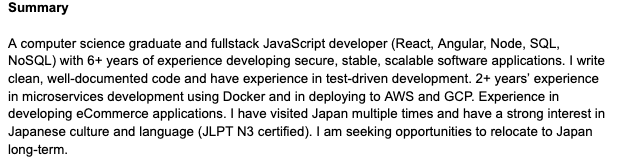
The second version shows a commitment to Japan not shown in the first example. It highlights Japanese language skills, past visits to Japan, and a clear statement of intent to work here.
State your interest in Japan explicitly, even if it’s just to state that you want to relocate here. It can help differentiate you from other applicants.
Final thoughts
I hope this article has helped you better understand your resume from the reviewer’s point of view, allow you to fix these mistakes if you have them, and get the interviews that your skills and experience deserve.
For more on resumes, read my general guide to writing an English tech resume for Japan.
As always, please feel free to get in touch via my Contact page.
Looking for a new IT job in Japan? Check out my job board. Hiring? Get in touch and let’s see how I can help.
Join 1,000+ readers to receive my free newsletter.
1 monthly email with Japan IT job news, articles on tech & life in Japan, my insider insights, and more.
100% non-corporate and non-boring!
- No spam, ever. Email addresses are never shared. You can unsubscribe at any time.