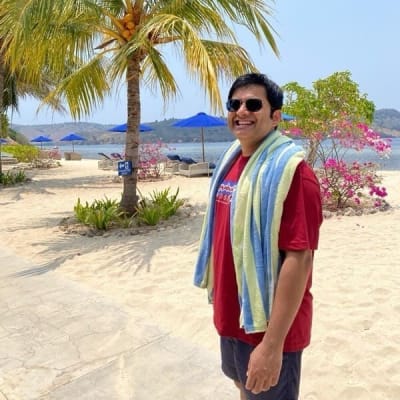
Paul: Ved Kamat is a bilingual solopreneur offering AI-first project and product management consulting in Japan.
Ved and I spoke about his unique childhood, transitioning from software engineering into project and product management, job hunting in Japan, life as a new dad, his new direction as an AI-first consultant, and more.
Hi Ved. Please tell us a little bit about yourself.
Ved: Hi Paul, thanks for the chance to talk about myself! My name is Ved – I am a happy 38-year-old, originally from India and currently living in Tokyo. I’ve been here for 13 years now, cycling through all the phases from wide-eyed Japanophile, to jaded salaryman, and back out the other side now to a very optimistic soloprenuer who plans to be here for the foreseeable future!
I was originally an engineer back in India, but my career in Japan has been in project, product and program management roles, from large consulting projects to working with small startups. I think I’m good at bridging between a domestic Japanese sales/business side and a global tech side, and I’ve built my career off that!
Tell us about your childhood. Were you interested in computers growing up?
My childhood was interesting – my parents and I moved countries 11 times in the first 18 years of my life, so I spent a lot of time in New Zealand, Australia, the US and India before my parents finally suffered from an extreme bout of patriotism and moved back to India for good! So it was an eclectic childhood moving between Western and Indian values and education.
I was interested in a lot of things growing up, computers being one of them (at one point, I learnt HTML and was building websites for clients when I was like 12), but I never thought I would be a developer long term, and sure enough, that part of my career didn’t last long. I was much more interested in people, culture, and language – probably because I was able to see so much of the world at an early age.
That’s a lot of upheaval. How did you manage that many new schools, relationships with friends, and so on?
Most of my time until college was in the days before social media, so when you left a school, you really left everything behind. It was difficult at times, and I was probably quite focused on self-preservation and fitting in, and expecting to move on, and so unable to foster deep friendships. On the flip side, it helped me become someone who gets along with all sorts of people, which I appreciate a lot now in adulthood. But it was definitely challenging as a kid, and a source of great whiplash when I’d go from a popular kid to someone with no friends, and back to being popular in the space of a few years!
You graduated with a B.Tech. in IT from TSEC, an engineering college in Mumbai. You have a great line on your LinkedIn profile: “Managed to never let college interfere with education. But also developed a core knowledge base in IT, which serves well today.” Could you elaborate?
People who went to college in India can probably relate to this, but I was not really “in” college, strictly speaking, I was more in the general vicinity of the building most days.
For me, as someone who had recently returned to India, college was a chance to soak in life in Mumbai and reorient myself. And improve my horrific Hindi skills. And so I would say I didn’t really learn much in the way of technical skills, but I did learn, again, how to get along with different kinds of people. But it was an engineering college after all, and about half of my friends from college now work in the US at major tech companies, so you are sort of steeped in ambitious engineering thinking whether you like it or not.
How did your career progress after graduation and how did you end up in Japan?
I began as a developer at Infosys in India – one of the massive success stories from India’s software revolution (they’re quite big in Japan now too). I spent 3 years cosplaying as a developer before I realized I was not destined to write clean code sitting at a desk. And so I started looking at schools in the US, as you do. But I’d lived there already and it didn’t have a great allure for me. So I broadened my search to include Asian schools.
I should mention that in primary school in Australia, you can choose a second language – and so I had studied Japanese for a couple of years and had even come to Tokyo for a homestay/ryuugaku program for a month. I loved it – my host family mother cried when I left, and the family sent me letters for years afterwards. I distinctly remember them renting Hollywood movies to make me feel at home (and so it was that I saw the Travolta/Cage classic “Face/Off” sitting in the family room of my host family’s home in Chiba).
I always wanted to come see Japan properly one day. So when I looked at schools in Asia, I was able to get admission in a few, and ultimately chose to come to the International University of Japan (IUJ) up in the snow country in Niigata. It was a pivotal life choice that I am very glad I made.
Walk us through your career in Japan.
After I graduated with an MBA, I wound up in Tokyo and quickly realized nobody cared about my MBA. But my Japanese speaking was serving me well, even though I couldn’t yet interview properly in the language.
I made a second important choice, which was not to go back to a developer role (the one role that wouldn’t have needed language skills). I was determined to stick it out and figure out a “real” business job. I could probably write a book about all the do’s and don’ts during this phase – but in the end, a few weeks before my visa ran out, I convinced a consulting startup to bring me on as an intern. They were very kind to me and helped me get a foothold in Tokyo, though I don’t think I was that useful to them. But it was important to me to experience real Japanese workplaces and roles, not through the non-Japanese-speaking foreigner bubble.
From there, I spent a few years working in PMO in financial services (insurance and consulting) till 2017, then freelancing as a Project Manager/Product Manager till 2021, and then working for startups until early this year (SaaS, news app, and healthtech companies).
The financial services experience was pivotal in terms of building an understanding of workplaces in Japan, and credibility on my resume. The freelance phase was validation that I could attract customers by myself and actually work for myself. But the core expertise was always helping the business side execute with the tech side, regardless of vertical.
Could you describe your experience job hunting in Japan? For example, how did you typically find new roles, what did the application/interview processes look like, and so on.
I think that for your career in Japan, the first step is the hardest. Once you are in a Japanese job and start building a track record, things get progressively easier.
In the early days, I really tried to follow all the tips and advice you tend to receive as a foreigner looking for work – formatting Japanese-style rirekishos, going to job fairs, worrying about my suit and the color of my tie, and obsessing about my jikoshokai (self-introduction). Those things are not unimportant, but in hindsight, I wish I had taken a more gut-based approach.
I always found that the key was to shrink the competition pool – you are, whether you like it or not, unique as a foreigner in Japan. Do you want to compete with “all new graduates from Japanese universities” by listening to the explanatory sessions and standing in line at the job fairs? Or do you want to be in an applicant pool of one, talking to a company that has never hired foreigners before and is intrigued by you?
So later in my career, after I had a few years of experience under my belt, I had great success finding jobs through recruiters, direct networking at events, LinkedIn and other niche job boards. But I always focused on putting myself in a position to talk to the decision maker directly, from which point my Japanese speaking ability was also an important factor.
If people are interested, I wrote a post about offbeat career tips on LinkedIn, which you can read here.
You left your role at a Japanese healthcare startup earlier this year, deciding to jump into the world of entrepreneurship and consulting. What kind of work have you been doing?
This year has been incredibly exciting and challenging – my wife and I had a baby in the Japanese healthcare system (we are very positive about our experience), and I gained residency in Japan (no more visa hassles), and finally, I started a company, Seranova, through which I am planning to provide PM advisory services, with a focus on AI enablement.
I’m still ramping back up after taking a few months to really properly enjoy the new dad phase, which I wouldn’t trade for anything. But from here on out, I am going to work with Japanese clients (small to medium-sized companies with technology products) to help streamline their project and product management operations and become AI-ready. I have a lot of experience working as a Project and Product Manager in all kinds of scenarios, but the gen AI world is moving at a breakneck speed, so I am excited to understand how the jobs are changing and what skills and organizational configurations will be needed as we start handing off pieces of our work to AI.
It’s fair to say that Japan fell behind the rest of the developed world when it came to software. As you mentioned, there’s an incredible focus on AI and how it might invigorate Japan’s economy. As someone taking an active role in the Japanese tech scene, what do you see currently, and how might this play out over the next few years?
This is really an interesting question right now. While the software era rolled on, you feared Japan would fall further and further behind, as the talent gap widened, and more and more working-age people retired. So what will happen in the AI era is the question. I think Japan will continue to lag in terms of say “AI Adoption” surveys and AI unicorns coming out of the country.
But it seems like there is a pragmatic understanding of the necessity of adopting AI coming out of government – they recently published a bill on promoting AI, and intend to make Japan an AI-friendly country with lighter guidelines than the EU, for example.
There’s also risk aversion and worker protectionism – but in this next phase, perhaps that will be healthier for Japan? I think in countries with less protection, we will see a lot more job instability very soon.
There’s also the tension between the labor shortage crisis and the immigration backlash – so maybe they will just skip a few steps and jump straight into AI and robotics filling the elder care void, instead of immigrants?
All in all, I think there’s actually a relatively steady path available to Japan – invest in the research/infra side, partnering with major global AI players, create very positive adoption guidelines, but don’t start replacing people with AI explicitly, and explore cutting-edge AI use cases for areas with labor shortages to offset immigration concerns.
Indeed. The national and many regional governments seem to have come to realise the importance of a modern software industry, along with the risk of falling behind in AI (if the hype is to be believed).
What does your typical day look like?
Having a baby has actually fixed my routine – my days are now pretty regular!
When I wake up, I spend some time doing baby chores and then spend a little time with her as well, to give mom a break.
Then I am typically working from 10 am – 4 pm – client work on alternate days at the moment, and readying my business on the other days. I generally work remotely, but I also think it’s important to give your clients some face time, so I will swing by once a week, usually.
From 4 pm – 7 pm, I am helping wind down and get baby to sleep. Not a bad life, being a baby, eh!
From 7 pm – 9 pm, it’s time with the wife, and then after that, I am keeping an eye on the baby while doing some less structured work.
I like to think of my work day as 1) starting with sales/marketing stuff, which is hardest for me, 2) breaking up the afternoon tedium with admin/emails, 3) doing creative work and POCs in the evenings when my brain tends to be most active.
What are some of your goals for the future? Short-term, long-term, personally and/or professionally
The experiences of the last few months have really changed me. I’d have given you a whole table before, but it’s a lot simpler for me now – my long-term goal is financial and time independence through my business. I want to maximize time spent with family and friends, and on projects I care about. Everything is intended to be tuned towards that.
In the short term, there’s a simple hierarchy of priorities. First, my health – I can’t show up every day if I am a zombie. Second, becoming a good dad – there’s so much to learn and humility to show. Third, continuing to be a good partner – moms take on an outsize role with children, it’s totally incredible, and I think it’s important for the father to be a supportive force. That means being emotionally steady and honest with yourself. And finally, building a sustainable small business – it’s a long-term investment I am making, so that means continuous and regular work of a high quality.
Quickfire questions
– If you could go back in time to your arrival in Japan, what advice would you give yourself?
Don’t be scared to get into rooms where you are the only foreigner regularly. You get outsized information, friendships, and context there.
– What advice would you give someone considering leaving a full-time role to venture into the world of entrepreneurship in Japan, especially as a solopreneur?
I think it depends on your personality, but I think having a stable visa is an important factor. I always felt it was hanging over me otherwise. But next to that, I would say, try doing contract work or a side project while you are still working to get a feel for it.
– How do you learn new skills? What are you currently learning?
I am currently learning parenting skills, AI skills, and creative skills.
The parenting stuff is a couple of books I like and YouTube channels I trust.
The AI stuff is tricky – there’s so much information out there. Again, I feel the best route is to find thought leaders whose style you like on LinkedIn or YouTube and consume that. But with AI, you have to actively build, not just be passive.
With creative skills, I am trying to join groups to get out of my comfort zone – I am currently looking into creating “Riso zines” using a risograph printer, but seeing other people’s projects is very interesting.
What on earth is a Riso zine?
I recently discovered what they were called too lol. A riso zine is a small, self-published booklet or magazine that is printed using a risograph machine, a device invented in Japan in the 1980s. The process is supposed to make vibrant, uniquely textured print using colors made with soy or rice bran oil-based ink. They are supposed to be imperfect, DIY, low-cost type booklets that independent artists make for limited editions, not mass production.
– Tell me a few of your favourite or most recently read books, movies, podcasts, and games.
I am loving “Empire of AI” by Karen Hao. It pulls back the curtain on the Silicon Valley/AI tech bro world, and you understand what we are in an important but dangerous moment, actually.
On the subject of AI, I love Greg Isenberg’s YouTube channel – it’s very bombastically positive about AI, but it always sparks lots of ideas.
On dad-hood – there’s a lot of good books out there, but I found “We’re Pregnant! The First Time Dad’s Pregnancy Handbook” by Adrian Kulp very accessible.
– What’s your favourite place to visit in Japan?
I love Kagoshima – the way Sakurajima (the volcano) forms the backdrop of the city is amazing, and the food, ferries and scenery are lovely.
– What’s the best thing you’ve spent 10,000 JPY on in Japan?
My Bruno portable coffee maker. I love Bruno stuff.
Are there topics we haven’t discussed that you’d like to add?
Not really – I am curious what you think about the recent immigration / Business Manager visa issues, though. Is it a signal toward foreigners that Japan is not going to open up further, or is the concern overblown?
That’s a good question. The number of foreign residents in Japan has more than doubled since I moved here in 1999. The makeup of the foreign population also changed considerably, from long-term resident groups (e.g. Zainichi Koreans, Nikkei Brazilians) to more labour-focused immigration (e.g. from Vietnam). At the same time, the number of tourists has increased from around 4.4 million in 1999 to around 33-35 million in 2024 (and probably more this year). That’s a lot of change for Japan to get used to in a generation.
The vast majority of foreign residents and tourists behave exceptionally well, but that doesn’t make the news. And blaming outsiders continues to be a reliable way to grow a political career (a lot easier than looking at your own failings). Put these all together, and there was bound to be some pushback eventually.
The recent Business Manager Visa changes were quite severe. If the concern was abuse by people setting up shell companies to gain long-term residency in Japan, I think that could have been handled by more surgical changes to the rules, along with active enforcement. The downside is that legitimate innovators won’t meet the new requirements and will go somewhere else instead, taking their potential benefits to Japan with them.
Immigration is certainly under the microscope now, and I don’t know where this will lead us. I’m not overly concerned, but it’s important to stay informed and keep an eye on the situation.
So, finally, do you have any asks for our readers?
Connect with me on LinkedIn if you want to bounce ideas, or if you want career advice for Japan, or if you want to collaborate on a project. DMs are welcome!
Through my new company, Seranova, I am offering consulting services (project-based) for clients in need of bilingual PM/PdM services with an AI-first approach. If you’d like to know more, get in touch!
Oh, and stay tuned if you are interested in the topic of AI x Future of Work – I am launching a newsletter where I’ll be talking to Japanese professionals using AI in their work, with the goal of cutting through the hype to understand what is actually valuable.
Excellent. Thanks for sharing your story with us, Ved, and best of luck as you grow Seranova.
Looking for a new IT job in Japan? Check out my job board. Hiring? Get in touch and let’s see how I can help.
Join 1,000+ readers to receive my free newsletter.
1 monthly email with Japan IT job news, articles on tech & life in Japan, my insider insights, and more.
100% non-corporate and non-boring!
- No spam, ever. Email addresses are never shared. You can unsubscribe at any time.