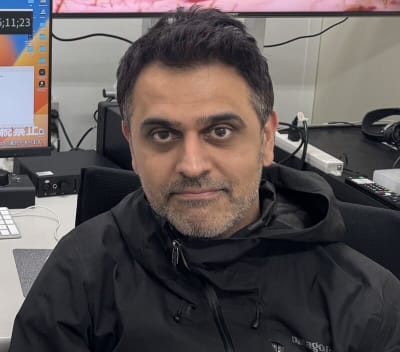
Paul: Janak Bhimani is a Yokohama-based brand strategist and a graduate of the Keio University Graduate School of Media Design.
Janak and I spoke about his early life in New Jersey, coming to Japan on the JET programme, developing his career at Fuji TV in New York, studying at Keio, working for NHK, NHK World, and on the Tokyo 2020 Summer Olympics, and much more.
Hi Janak. Great to catch up, as always. Please tell us a little bit about yourself and your early life.
Janak: I grew up in Jersey City, New Jersey, a stone’s throw from Manhattan, yet a world far, far away. New Jersey, for anyone who isn’t familiar, is the Saitama of America (like Essex in the UK, from what I hear). When I was growing up, it was a very diverse working-class town; now it’s totally bougie. My parents, like many immigrants, both worked full-time.
My early life was a typical American inner-city upbringing. While there was interaction with people from all walks of life and all corners of the world on a daily basis, I always had a longing to go out and see the world for myself.
You received your bachelor’s in English Literature in 2000 from Rutgers University. What kind of career goals or interests did you have at that time?
My interests while in university, like the interests of university students the world over, were social events, pre-games before athletic events, post-game parties after athletic events, and not being (too late) for class. Oh wow….I honestly didn’t think about my career goals until I was in my senior year at university. Everyone around me was interviewing and getting jobs at big companies in various industries — for reference it was the end of the Bill Clinton era in the US and the economy was very good. It was a different time where companies and corporations had money and resources. You didn’t necessarily need to have the exact background or skill-set for a particular industry as there were long rotation programs that allowed one to find their place within an organization. That was then; definitely not now. I followed suit and did the same by applying and interviewing. I was going through the motions but felt like something wasn’t clicking.
Then, one day there was a career fair on campus during the start of my senior year. I happened to see this Japanese man sitting at his booth with almost no visitors. He was from the Japanese Consulate General in New York and there to provide information about the JET Programme. I wanted to see what freebies they had so I went over. Plus, we all know what it’s like to be at a crowded party and not have anyone talk to you, so I thought I’d do him a solid.
I had no idea what the JET Programme was, nor did I have much knowledge about Japan. After speaking to the gentlemen from the Japanese government, my interest was piqued and I felt I had found my way to see the world for myself. Maybe something finally clicked. Also, he didn’t geography shame me for mistaking the Philippines with Japan on a map when he asked me where the country was.
So you came to Japan as a JET. How did life progress from there?
Remember how I said I was from the Saitama of America? Well, I actually ended up in Saitama, the New Jersey of Japan, on JET. After three years of being an ALT and freelance eigo no sensei (different times, different pay…. ah, the good old days), I went back to the USA with a B.A. in English Lit and three years of working experience as an ASSISTANT language teacher of English. Remember, those last years of the roaring Clinton era, yeah, those were over. The world was different due to the events of 9-11 and (all) I had the qualifications and experience previously mentioned.
One thing was for sure, I did not want to be in any form or transmutation of NJ/Saitama/(Essex). I was networking (quasi day-drinking/early happy hour) one day at a dive bar in the East Village. I was with some Japanese friends I had made in NYC and speaking Japanese, or at least what I considered to be Japanese in my state of mind and body at the moment in time. A woman approached me and gave me her card, she said to not lose it and to contact her whenever I woke up the day after.
With my head throbbing, I pulled out the card from the previous day and called. She was a coordinator for the NYC branch of a major Japanese TV network. I was hired as a freelance PA (production assistant; AD, assistant director in Japan). A short time later, after increasing my knowledge, experience, industry skills, and – most importantly, Japanese ability, I was hired full-time as a director/producer for Fuji TV in New York.
It was during this time in NYC working in TV that I was really able to develop and refine my project management, creative, time management, crisis response, localization skills, as well as greatly improve my Japanese ability, which was good since a majority of the people I interacted with on a daily basis were native Japanese speakers and the content I was making was in Japanese for a Japanese audience. Whether it was covering the MLB, the US presidential election, or asking NYers the name of the North Korean missile (FYI, most of the people interviewed answered Gyudon, and not the correct answer – Tepodon), I was juggling multiple projects with very real (live/on-air) deadlines, had almost no margin for error or failure, needed to deliver a creative product of high standards and accuracy to upwards of tens of millions of people and do it under budget… on a daily basis, before any kind of mainstream, accessible/ free live streaming option. We used satellites, y’all. And they ain’t cheap.
But fate led you back to Japan?
Interestingly enough, I was working at Fuji TV in New York and travelling extensively domestically and internationally. It was the roaring 2000s and everything was fine; but it actually wasn’t. I created a lot of content and covered many, many topics. I was criss-crossing the country, heavily covering the MLB and the (then) upcoming 2008 election. It was during these business trips, while interviewing people from various backgrounds and getting a lay of the land for research purposes, that I realized ‘something is rotten in the 50 states’. Following leads in the world of finance and banking, my suspicions were unfortunately proving to be more fact than fiction with phrases like sub-prime loan entering into the daily news lexicon.
It was around this time that someone from the JET AA (no, it’s not that organization; the alumni association) of New York informed me about the MEXT scholarship for graduate study in Japan. I hadn’t really given much thought to going back to school, but seeing as where things were headed, I started considering it. I knew I wanted to do something innovative with content creation and design. I found a very new graduate program that was just launching. I applied, interviewed and got the scholarship. Fast-forward a few months, I was covering people walking out with boxes at different financial firms and filming the stock market ticker going in the direction no one wanted it to go. That was one of the last topics I covered before leaving my job, my family, my country, and once moving to Japan… this time not as a teacher, but, rather, a student.
Back as a student, this time for a master’s and a Ph.D. in media design at Keio University. I’ve heard great things about Keio’s Graduate School of Media Design (KMD). Tell us about that experience.
KMD had just launched when I applied for the MEXT scholarship. I was in the 2nd Spring intake cohort. At the time, the school had a Spring and Fall intake. Master’s required courses were taught in Japanese for Spring intake students and English for Fall students. After improving my Japanese ability in New York, I thought why not see how capable I was in the country that takes its name from the language (or vice-versa). Being in an academic setting immersed in Japanese was definitely challenging, but not as challenging as being one of only two non-asian, non-Japanese students. The Spring intake was not only much bigger than the Fall intake, it was also primarily made up of Japanese students and some people from East Asia. I stand out almost everywhere in the US. This was amplified. Needless to say, it was noticed when I was a tad bit late (or hungover) for class.
My graduate experience was good because it gave me the freedom to pursue research I was interested in with professors who were supportive. During my master’s program, I focused on how digital content creation can be utilized to enhance children’ s expression through workshops and user experience research. I was able to collaborate with engineers, programmers, designers, and people with other expertise to create projects that went from 0 to 1+.
I finished my master’s program in March 2011 and was going to continue on in the doctoral program. On March 11th, 2011, the Great East Japan Earthquake devastated the Tohoku region. It was so strong that I, like many others, felt the effects as far as Yokohama. I was on the Hiyoshi Campus of Keio University where KMD is located. After a crazy amount of shaking for what seemed like forever, someone turned on the 1 Seg broadcast on their flip phone (ガラケー). Since mobile signals were weak at best and the power grid was suffering black outs in many places, it was the only way we could see, in real-time, what was happening.
The domestic and international news over the next few days was covering the havoc and its aftermath. People, whose lives, livelihoods, and communities had been upended in an instant, were in trauma, living in evacuation shelters, being interviewed and asked how they were feeling. You don’t need a degree to figure that out. I felt angry and ashamed at the same time. If I was still working in mass media, would I be doing the same thing? Probably. My anger stemmed from the fact that each person being interviewed had a story to tell, in their own words and their own way that couldn’t be captured in a short soundbite.
I decided to shift my research focus to visual storytelling through creating collaborative community-based content. While I was in the master’s program, I was lucky enough to be able to work on some projects using 4K cinema cameras. I know you’re laughing because it’s something anyone with a smartphone can do easily today. It was not accessible or easy back then. I directed a short 4K user-generated documentary with stories told by people who experienced the disaster. The documentary was shown at a special screening during the 2011 Tokyo International Film Festival.
As my research progressed, I focused more on facilitating real-time collaboration for content creators that were both co-located and in remote locations. Through my research I was lucky enough to travel very often to present my findings at various conferences around the world.
I had my son while I was in the second year of my doctoral studies. This sped up the timeline for me to finish and graduate. While I did have full scholarship, monthly stipend, and other research grants, I realized being a professional student was not a viable option. I was doing some freelance work while I was in grad school but increased that because diapers don’t grow on trees. I also wanted to finish at the end of my third year as that is when my scholarship ended. And I did. Life and reality are great motivators.
You’ve been working as a freelance digital media consultant since 2014. What kind of projects have you worked on?
After graduate school, I really wanted to stay in academia. Having come from the professional world with real deadlines and budgets, I was able to produce results and deliverables in my research. I was offered some post-doc opportunities both in Japan and abroad. When I realized the reality of postdoc life — short-term, low-pay, uncertain future — combined with how pure academics didn’t consider, and in some cases resented, previous professional experience, I realized I’d try to utilize what I’d picked up in my graduate studies with my professional background, experience and network.
I have been and continue to work with NHK and NHK World. I sometimes do narration and voice overs. My best known voice-related work is probably the four part documentary series – 10 Years with Hayao Miyazaki. Since 2016, I helped launch and have been in charge of remaking and adapting the Japanese version of the famous TV program ダーウィンが来た! into Darwin’s Amazing Animals for a global audience. The job involves localization, cultural adaptability, editing, and writing dad jokes, to name a few.
On the academic front I have been able to keep my ties to learning as well. I am a guest lecturer for undergraduate and graduate students teaching narrative visual storytelling in both English and Japanese. Since 2015, I have been involved with providing content strategy, localization, and editorial oversight for Keio University’s EdTech initiatives, including its first open online courses on the Future Learn MOOC platform.
In 2017 I was asked to be a part of the Tokyo 2020 summer Olympics full-time as a member of the design team. When I joined, not only was I the only native English-speaking non-Japanese person on the team for the biggest global sporting event, most of the members and those in managerial positions were seconded from a well-known Japanese advertising firm. I was a senior manager in charge of Brand Strategy for Tokyo 2020 properties. My function on the BIL (Brand, Identity, and Look) team was to ensure that anything visually related to the Olympic and Paralympic Games met the standards set by Tokyo 2020, the IOC, the IPC, as well as other partners, stakeholders and corporate sponsors.
Besides being physically different (looking) from every member of the team, I brought a different perspective and approach to the team. Our team was responsible for creating the Look of the Games – the design/motif that is created by and unique to Tokyo 2020 – and other Tokyo 2020 properties.
One of my greatest memories is conceptualizing and creating the theme and copy for the TOKYO2020 Test Events.
Another fond memory I had relates to an unwritten part of my professional purview – putting out fires. I was asked to come up with a short-list of names for what to call the Tokyo 2020 volunteers. One day, I was asked to join a meeting where this would be presented to the higher-ups… that was taking place in a matter of minutes. Unbeknownst to me, a certain domestic advertising company had already reached out to “professional naming” companies in Japan.
From the moment the meeting began, I realized why I was asked to join at the last minute. The elder statesmen-like higher ups, in their golden parachute glory, were not impressed by any of the suggestions from the “professional naming” companies.
That is, until the name “Tokyo Escorts” was suggested. It was a humdrum of smiles and affirmations amongst the Bubble-era boys. It was like an auction, and before the gavel could fall and seal the deal, I assertively explained why “Tokyo Escorts” would not be in the best interest of anybody. In the end, the Tokyo 2020 volunteers were called “City Cast” and “Field Cast”… thankfully.
That would have gone viral for all the wrong reasons!
Since Tokyo 2020 finished, I have been working freelance full-time and then some. Thanks to my baptism by fire in the world of design on such a huge international scale, I have been able to take on some content strategy projects.
What does your typical day look like?
An interesting aspect of freelance work, I find, is that there is really nothing typical in terms of schedule or scope. However, with two kids in school, I am up in the morning most weekdays to make sure that no one is (too) late going to school.
I try to exercise for about one hour. I normally tackle my work, personal, family to-do lists. If there is a lull in work, I check out what’s going on in the world of job opportunities.
I’ll also squeeze in time to focus on learning a professional skill. I go out to networking events in the evening if my schedule permits. Before I call it a night, I try to squeeze in a few Duolingo lessons.
What are some of your goals for the future? Short-term, long-term, personally and/or professionally?
A goal that many people probably share with me is finding some stability financially and in general in this unstable present moment.
Short-term, I’d love to work with new clients in industries that I haven’t worked in before like tech or start-ups. In the long-term I’d like to find a professional opportunity that takes advantage of my personal, professional, and academic experiences.
Quickfire questions
– If you could go back in time to your arrival in Japan, what’s the most important advice you’d give yourself?
Don’t be so American. Take in the sights, sounds, smells, and experiences for what they are. You’re not in Kansas (or New Jersey) anymore. Silence can speak volumes.
– What advice would you have for a mid-career professional thinking of going back to school for a graduate degree?
Before November 2022 (i.e. pre-ChatGPT), I would say do it if: it’s really something that you, yourself, in your heart of hearts, wants to do; someone else (a company) is paying for it and it won’t adversely or negatively effect or career or professional journey; if it’s for career advancement and professional certification suffices, then don’t jump into the pool of post-grad education when dipping your feet poolside is enough.
After November 2022, I would say: pursue it only if you have a passion for it. Getting a graduate degree or degrees, except for something discipline/profession related (JD, MD, MBA, etc.) is something you need to do for you, not for anyone else.
– How do you learn new skills? What are you learning currently?
I have been on Duolingo for 790 days as of this submission. I originally started using it because I wanted my children to use it to keep up with their English as they have only gone to Japanese schools. While I have been told my Japanese is of a high-level and I have never had any issue using it in a professional, personal, or academic setting, I find the app helps me stay on my toes with Japanese.
I also started learning Spanish. I regret not picking it up sooner as I am from the US and Spanish opens the door to communication with over 600 million people globally. Lastly, I have attempted to formally learn Hindi. While I can understand it somewhat, it is a travesty that I can’t speak, read, or write it well.
I have also been brushing up on my professional skills as we live in the age of skills (rather than education or experience…according to some). I have been learning digital marketing in order to get a certification. I’m also taking various courses related to Google Ads to get certified.
The most important skill I have been learning and trying to master for as long as I can remember is keeping calm in the face of uncertainty so that I can be an example and resource for others.
– Tell me a few of your favourite or most recently read books, movies, podcasts, and games.
I was a voracious reader up until I finished my graduate studies. I’d be so sick of reading what I would need to read for my research that I’d pick up unrelated books in the library and enjoy them. It was my way of positively procrastinating.
I am re-reading Sapiens by Yuval Noah Harari. It’s not a light read by any means but it is informative and very applicable to the times we find ourselves thrust into. One of my favorite authors for the last few years has been J. M. Coetzee.
The last really good movie I saw was Venom 3 with my son. People are gonna hate on it because it’s about a sentient alien symbiote from outer space. But from the perspective of narrative and entertainment, it tells its story with climax, crescendo, conclusion, and a cliffhanger while evoking emotion in the audience and closing the chapter on an underrated franchise and actor (Tom Hardy) — all in well under 2 hours.
I don’t watch movies as much as I’d like to because I don’t like breaking up my movie watching into chunks. I do believe we are in the golden age of TV (that isn’t on TV, per se). Content from all over the world is accessible and enjoyable like never before. If you haven’t seen it, check out Moving. Besides having a great cast and rich narrative, it reminds us that sometimes being a regular person is harder than being a superhero.
I have always been a huge fan of content out of the UK and Ireland. When I was young, we didn’t have cable TV at home. So we’d have to watch public broadcasting. This was my exposure to Faulty Towers, Benny Hill, Are you Being Served, and Doctor Who, to name a few. To this day, I credit both my use of double entendre and my fear of Daleks to this indelible chapter of my formative years.
I don’t really listen to podcasts as much as I did when the medium was maturing. From time to time, I do listen/watch to Drink Champs, the Midnight Miracle, Club Shay Shay. Any suggestions are welcome.
The only game that I regularly play is SWGOH (Star Wars Galaxy of Heroes). I really need to stop/cut down my involvement but I’ve been playing since it launched and I’m in a really strong guild.
– What’s your favourite place to visit in Japan?
Fukuoka. If you don’t know, then go. Everything about it is awesome — the people, the food, the atmosphere, an airport in the middle of the city (like San Diego), the access, the affordability, the lack of too many tourists and (lack of) schmuckery found in other major cities. Seriously, go now.
– What’s the best thing you’ve spent 10,000 JPY on in Japan?
I’d like to say Takarakuji, or the lotto, but the most I’ve ever won was 3,000 JPY on 900 JPY.
Very recently, my family had lunch at Saizeriya. Everyone ate and drank (non-alcoholic beverages) to their heart and stomach’s content and had leftover pasta to take home for under 5,000 JPY. The remainder was used to go grocery shopping for a few necessities. BooYah!
Are there topics we haven’t discussed that you’d like to add?
Totally unrelated – a lot of people in Japan who aren’t baseball fans have, in the past few years, become fans of the sport. That is wonderful. Baseball is a great sport. I was blessed to get paid to cover (watch) baseball games for a few years. I never complained about being overworked or underpaid when I was standing on the field at Yankees Stadium.
All that being said, there are currently 30 teams in the MLB, not just one particular team from LA. Just sayin’. If you are not sure who to follow, may I suggest the New York Yankees. They’re an amazing team with great players and a man that deals justice not with a gavel, but a bat – #99 Aaron Judge.
If anyone from the MLB sees this or if someone reading this knows anyone from the MLB, don’t be a stranger. I can help make the World Series a truly global phenomenon.
Good luck with that but I think you’ll have some difficulties overcoming the Ohtani effect!
Finally, do you have any asks for our readers?
I’d like to thank you, Paul, for this great opportunity. Our meeting at a professional networking event last year was really serendipitous! I’d like to thank everyone for taking the time to read this interview and get to know a little bit more about me.
For all the professional and personal resources out there, it is really difficult to get to know someone in-depth. I’d really like to get to know some of the people reading this as well. That being said, I am very open to any and all interesting professional opportunities both here and back in the US (since I can work in both places). I’d especially love to work in the start-up or tech space. My hope is that I can be a bridge between Japan and the world while enhancing my knowledge, and hopefully my retirement fund.
If you are looking for a grassroots ambassador who can deploy and operate on a global scale, look no further. I can be to your organization what the Zoroastrians were to India in the 8th century. Like the story of the Zoroastrians who came to India from Persia, adding me to your team will be like adding sugar to milk. I will enhance, not unsettle, the situation.
Feel free to connect with me on LinkedIn. I’m looking forward to it!
Thanks, Janak. Always fun catching up with you.
Looking for a new IT job in Japan? Check out my job board. Hiring? Get in touch and let’s see how I can help.
Join 1,000+ readers to receive my free newsletter.
1 monthly email with Japan IT job news, articles on tech & life in Japan, my insider insights, and more.
100% non-corporate and non-boring!
- No spam, ever. Email addresses are never shared. You can unsubscribe at any time.