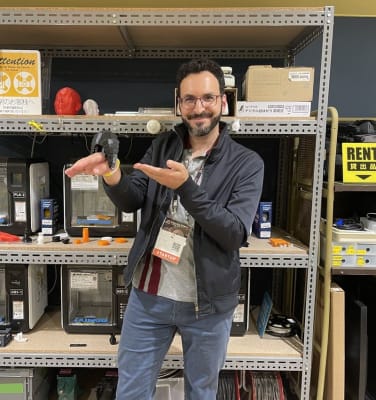
Paul: Joe Baz is a highly accomplished product design leader who moved to Japan with his family in 2023.
Joe and I talked about his early career in the US, relocating for a new life in Japan, starting the Musubi Tech community to foster innovation and multiculturalism, advice for anyone trying to build a career in product design, and much more.
Hi Joe. Great to catch up again. To get us going, tell us a little about you.
Joe: Hi, my name is Joe Baz. I’m from the Boston area, but I’ve lived in different parts of the US including Washington DC, San Jose, and Connecticut. I’m married to a lovely Japanese woman, and we have two children, 5 and 8. By the way, they are already fluent in Japanese, and yes, I am a bit envious!
You studied fine arts, printmaking, painting, and graphic design at university. Have you always had an artistic streak? What kind of career were you interested in having?
I was all over the place at school. Funny enough, I hated learning before going to college. And then something clicked and I couldn’t get enough of learning. But I didn’t know what I wanted to be. I started with a focus on graphic design. The next semester I switched to Illustration. The semester after that it was painting and printmaking, because why not? Before graduation, I also had enough credits to minor in history. That’s how scattered I was.
But something amazing happened. It was my 2nd year of study. I signed up for an English Literature class and the teacher had us meet in the computer lab. Of course, I was confused, but it started getting weirder. “We’re going to learn about famous literary figures online,” my teacher expressed. (This was 1996 mind you.) “And your final project will be to build a website on an author you pick… like an online book report.” So, part of the class involved reading, and part of the class involved learning HTML. And I was immediately hooked!
Fast forward to the end of the semester, I had 4 studio art classes and this Lit. class. I was pulling all-nighters left and right to keep up with the studio workload; it was so intense. However, I managed to always carve out enough time to work on the website. Well, I also needed to submit two essays to my Lit. teacher via email by noon on a particular day. “No problem!” I thought. Except when I got home at 8 am from the studio and started writing the essay I fell asleep on the keyboard. I MISSED THE EXAM! But, when I got my report card I got an A in the lit class and Bs and Cs in my studio classes. I asked the teacher “Why? I missed the exam?” and her reply was “I just loved the website so much.”
At that moment, I knew that my career wouldn’t be born out of academia.
How did your career develop after university?
After graduating from the University of Connecticut, I wanted to get out. More specifically, I wanted to live in Silicon Valley. I packed my bags and flew out to California to stay with my uncle. I didn’t have a job.
My uncle was able to find me a job opportunity at the company he worked at as an NOC (Network Operations Center) agent because I could get stock options. I turned it down because a) staring at a computer screen from midnight to 8 am didn’t sound appealing at all, and b) I had no confidence that the gamble on the options would be worth it (they weren’t in the end). I had my eyes set on one thing only: web design.
I did land a 6-month contract for my uncle’s company as a web developer shortly after I moved, which was exciting, and eventually, my job hunt concluded as I became a web designer for an Internet Service Provider (ISP).
In an interesting plot twist, the ISP was bought by a telecom company, and the web team, which observed my work during the intense rebranding exercise of the merger, said “Do you want to work in the Marketing or Engineering department?” Can you guess which path I took?
Was it a mix of both?
Actually, it was Marketing. I thought that would be the best path as I was more interested in business than code. Interestingly enough, many of the projects I worked had more to do with software design than web marketing; it’s where I learned UI design, prototyping, and usability testing…all self-taught since there were little to no UX programs at the time (2001-06).
You’ve worked for companies and also worked for yourself. What kinds of lessons have you learned from each way of working?
From a CEO perspective (I ran a UX consulting business for 10 years), the biggest lesson I learned involves the challenges of hiring close friends and maintaining professional boundaries. I had difficulty separating my personal and professional life from my friends. As a result, this made decision-making and interpersonal conversations extraordinarily difficult.
From a startup perspective, my biggest lesson learned was to seek multiple mentors to guide my career path. At a previous employer, I wore a lot of different hats – Product Manager, UX designer, and front-end developer – and it was difficult to separate myself as a leader vs. an individual contributor. (Also a lesson when I ran my own company early on.) More specifically, I didn’t spend enough time looking at how to scale the business, which might have provided me with more opportunities to be a leader instead of an individual contributor.
From an enterprise company perspective, the biggest takeaway for me was that when you have a hybrid people manager and strategist role, it can be very tricky for your direct reports. Are you giving them direction or trying to coach them? There were times when I needed to let my team figure things out for themselves, and other times I needed to step in because there was a strategic misalignment with their work. The challenge was being clear when I spoke to them, which wasn’t always the case, and created confusion.
Yes, all my lessons have to do with separation anxiety. 😉
You moved to Japan about a year ago. Why Japan? What’s your impression of life in Japan so far?
This is a relatively easy question to answer on the surface: My wife is Japanese and we have two children. Since they are half, we wanted them to experience part of their lives in Japan. It’s very important to my wife and me that they grow up multiculturally (a theme you’ll see more of later). There are plenty of opportunities for us to teach them the difference between American and Japanese culture. A classic example is, “Dad, why are slurping your noodles? It’s gross.”
While I’ve only been here for a little over a year, I’ve also been visiting Japan every year for the past 12 years. Additionally, Shintoism is big in the family and so I’ve gotten to experience a lot of things: weddings, funerals, 七五三(a coming-of-age celebration for children), 節分祭り(I got to toss the snacks and candies into the crowd twice), and the list goes on.
There are a couple of things that match my personality and values in Japan. One is around compassion. For the most part, I find people in Japan are very compassionate. I’ve had so many random encounters of passion as compared to the US. In the US, I just get flipped off for making a dumb mistake.
Secondly, I like structure. Sometimes things can be over-engineered in Japan, but I still appreciate having some predictability. I have enough unpredictability in running a business, so it’s nice to balance things out.
Lastly, safety. Do our children have to get training on earthquakes in the classroom? Yes. Is it less stressful and traumatic than getting shooter training? BIG YES. And, I don’t have to worry about my safety. It’s nice to know that you can leave things behind and somehow they magically return to you. Or you don’t have to worry about getting mugged like my poor friends did after leaving my house party in Washington DC years ago.
You’ve taken an active interest in Japan’s tech community since you arrived. Tell us about that.
In 2007, I moved from DC to Boston without knowing anybody. I figured that one way I could make friends was by starting a community, and so Boston Frisbee – an ultimate frisbee community for beginners – was born. It had such a transformative effect on me. It made me realize that one of my values is helping others. It’s still running to this day with over 5,000 members.
From there, I supported another community called BostonPHP, where I helped bring speakers and helped with one of their conferences. The second transformative effect occurred: supporting communities is great for professional development, both in terms of growing one’s network and opening one’s perspective.
When I came to Japan last year, one of the first things I did was to support a community: I joined Product Tank Tokyo as an organizer and helped run events.
This leads to the new community you’re setting up, Musubi Tech. Why create a new community now and what would you like this community to accomplish?
Excellent question! While at Product Tank, I asked the organizers two questions: What problem are we trying to solve, and why are we the best ones to solve it? They were difficult questions to answer because everyone worked full-time or went to school. So I took it upon myself to interview the community. I spoke to 16 people – mostly product managers, but also some designers and engineers. I also reviewed the results of a survey that had over 120 responses. What I learned from the survey was that there were two main problems:
- Tech professionals need help breaking into the field of product management
- Seasoned tech professionals want to meet like-minded people and learn from one another
While interviewing members of the community, I thought about how isolated our community was and how limited our conversations about our field of practice really were. Then it clicked! Like my family’s motivation to raise our kids to become more multicultural, I saw an opportunity to do the same for the tech community. How might I help foster multiculturalism and innovation between the Japanese and International tech communities in Japan? And so, Musubi Tech was born.
I envision a future where future generations of tech professionals who come to Japan know where to start on day 1 of their journey in Japan: from acculturation to learning best practices. I equally see a future where members of the Japanese tech community get a spark of curiosity to learn different methods of innovation from the International community. It’s a vision where multiple generations of multicultural tech leaders are born, and positively contributing to Japanese society and beyond.
What does your typical day look like?
I get up around 6:30 every morning, make the kids breakfast, and get them ready for school. Before my work day starts, I plan out my day by looking at my backlog (yeah, total product nerd) and prioritizing what I want to accomplish for the week and the day. At around 9 o’clock, I meet with my Japanese tutor for an hour.
Then I will either: a) work from 10-5 on Musubi Tech and my freelance gigs, or b) head into Tokyo for a bunch of 1:1 meetings followed by a networking event in the evening. I’m usually in Shibuya or Toranomon Hills twice a week.
What are some of your goals for the future? Short-term, long-term, personally and/or professionally?
In the short term, I want to find a sustainable business model for Musubi Tech and grow it beyond Tokyo. I would like this to be my sole focus professionally. I aspire to become more fluent in Japanese to fully engage in conversations and storytelling.
Long term, I want to retire in Japan, but still work on meaningful problems in society, like climate tech and healthcare. I can picture myself living in Matsudo (I’m living in my dream home now), but also having a vacation home in a semi-rural area of the US… Vermont is very appealing.
I would love to travel and experience more cultures, maybe even live in a country for a short period to experience the most of it.
As an experienced product design leader, what advice do you have for someone trying to enter the industry, especially in Japan?
I empathize with folks who are trying to break into the industry, especially if they don’t know Japanese because the market is very tough right now. If you are struggling to get interviews, then seek alternative means of doing work and building your portfolio or case studies in Japan. It might mean volunteering for an organization and helping them with their product challenges. Perhaps it’s participating in a hackathon or even designing a product of your own.
Secondly, network with people. Right now, there’s a ton of competition for tech jobs, especially for folks who don’t speak Japanese. Continue to grow your portfolio and share it with people you meet.
Also, don’t underestimate recruiters in Japan. The recruiting industry is big here, and you will want to build relationships with them. You will most likely run into recruiters at events but don’t be afraid to ask for introductions from folks within your network either.
Quickfire questions
– what’s the most important piece of advice you’d give yourself if you could go back in time to your arrival in Japan?
Study Japanese. I took it for granted and I could have great conversational Japanese if I took it seriously since my wife had been teaching my son since he was born.
– how do you learn new skills?
In the last couple of weeks, I was relearning what it takes to build a business plan (yeah, still important in this day and age for tech startups) as well as how to do LinkedIn advertising.
– tell me a few of your favourite or most recently read books, movies, podcasts, and games.
I am currently re-reading The 7 Highly Habits of Highly Effective People by Stephen Covey [Amazon] and just finished reading Japan Business Mastery by Dr. Greg Story [Amazon], which I am very excited to read.
I regularly listen to podcasts such as Disrupting Japan by Tim Romero, Scaling Japan by Tyson Batino, Business Success Japan by Lydia Beukelman, and History of Japan by Isaac Meyer.
I am a sucker for games that have character progression like Destiny, The Division, and Death Stranding.
Some nice choices there, especially the podcasts [I’ve appeared on Lydia’s:-)]. I don’t know the History of Japan podcast – I’ll have to have a listen.
– what’s your favourite place to visit in Japan?
I love Hakone! It is renowned for its hot springs, which have been celebrated for their healing properties for centuries. The onsen culture in Hakone is a significant part of Japanese relaxation and wellness traditions.
Additionally, there are many attractions to see, such as the Open-Air Museum. The family and I usually take the Hakone Ropeway to see the steamy mountainside and the Kura-Tamago 黒卵 (“Black Egg”) monument at the Kurotamago House. We’ve been fortunate enough to catch a glimpse of Fuji san on one occasion.
– what’s the best thing you’ve spent 10,000 JPY on in Japan?
I can’t answer because I don’t remember how much I spent on things in the past. A palm reader once told me “You will make a lot of money, but you will be terrible at managing it.” It’s so true. (Calling all finance folks, Musubi Tech needs you!)
Are there topics we haven’t discussed that you’d like to add?
Yes, in fact. We all benefit from clearly defined concepts to avoid misunderstandings. For example, when people talk about innovation in Japan, are they using the definition by Merriam-Webster or innovation as a discipline defined by Peter Drucker or someone else? Even if one disagrees with the various folks that have defined innovation, come up with one, because without definitions, we rely on our unconscious bias to steer our conversations in potentially unproductive ways.
Finally, do you have any asks for our readers?
Without implying anything about your readers, I generally make this ask of others: Despite our differences, show compassion.
We’re all human. We may differ in appearance, personality, skill, values, etc., but we all bleed the same. We all have emotions. Even if you don’t like the person, they lack social skills, or whatever it is that bothers you about them, try to empathize with them.
It’s not easy and by no means am I perfect (I fail at it from time to time). Still, I feel it’s important to keep top of mind at all times.
Thanks, Joe. A good thought to end on. Best of luck to you as you grow Musubi Tech.
Looking for a new IT job in Japan? Check out my job board. Hiring? Get in touch and let’s see how I can help.
Join 1,000+ readers to receive my free newsletter.
1 monthly email with Japan IT job news, articles on tech & life in Japan, my insider insights, and more.
100% non-corporate and non-boring!
- No spam, ever. Email addresses are never shared. You can unsubscribe at any time.